Surprising claim: the most privacy-preserving mobile wallets are often the ones doing the most behind-the-scenes routing and coordination — and that work changes the shape of risk as much as it improves usability. For privacy-focused users in the U.S., the promise of swapping XMR for BTC or converting LTC with MWEB enabled inside a single app looks like a clean, private solution. But the mechanism that delivers that convenience — on-device key control, decentralized routing, or integrated market makers — shapes different threat surfaces and trade-offs than a non-custodial wallet + external exchange model.
This article compares three practical approaches to “exchange in wallet” on mobile privacy wallets: (A) integrated decentralized routing using intent systems and market makers, (B) on-device peer-assisted swaps (coinjoin-like or PayJoin style), and (C) external custody-free exchanges initiated from the wallet interface. I use the design choices and feature set of modern privacy-first mobile wallets as a baseline — device-level encryption, Tor/I2P connectivity, non-custodial key management, MWEB and Monero support, and hardware-wallet integration — to show where convenience intersects with privacy, and where hidden costs crop up.
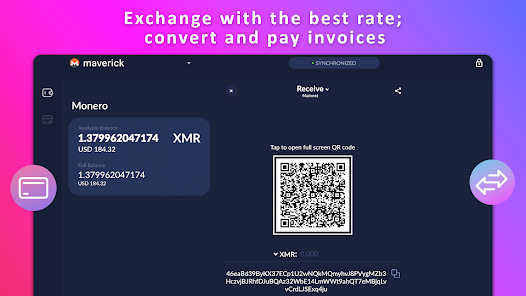
How “exchange-in-wallet” works: mechanisms and common architectures
At a mechanism level there are three building blocks that enable swaps inside a non-custodial mobile wallet: liquidity sourcing, routing/settlement logic, and privacy-preserving networking. Liquidity sourcing means where the counterparty or price is found — centralized order books, independent market-makers, or peer liquidity pools. Routing/settlement is the set of on-device protocols that actually convert asset A to asset B without the wallet holding custody. Privacy-preserving networking controls metadata leaks: Tor-only modes, I2P proxies, and the ability to connect to user-selected nodes.
Take the NEAR Intents model used by some wallets: it automates decentralized routing by querying multiple market makers and liquidity providers, then settles a swap via atomic or staged ops without requiring the wallet to deposit funds into a central account. That preserves the non-custodial property in principle, but still depends on the correctness and incentives of the routing layer — and on the market makers’ behavior — for privacy, fees, and execution quality.
Contrast that with PayJoin v2 and Silent Payments on Bitcoin: these are technically peer-assisted transaction constructions that mix inputs or obfuscate the payer/payee link at the UTXO level. They don’t require a liquidity counterparty because they rearrange existing UTXOs to achieve privacy. For Monero or MWEB-enabled Litecoin, privacy comes from protocol primitives (ring signatures, bulletproofs, and MWEB blinding); swaps must respect those mechanics or act as bridges, which is technically nontrivial.
Comparative trade-offs: three alternatives
Below I compare the three architectures on the dimensions privacy, trust model, UX friction, and failure modes. This is a pragmatic comparison intended to help you choose depending on how you weight each dimension.
Option A — Decentralized routing via intent systems (e.g., NEAR Intents)
How it works: the wallet broadcasts an intent for a swap, receives quotes from market makers, selects a route, and coordinates settlement without depositing funds into a custodial service. Advantages include better price discovery, multi-hop cross-chain capability, and integrated UX. It often supports dozens of assets within the app, so users can convert XMR ↔ BTC ↔ LTC ↔ ETH quickly.
Trade-offs and risks: although non-custodial, privacy depends on the routing network’s topology and the market makers’ operational practices. Even with Tor/I2P, pattern analysis across routes can reveal linkable events. Execution failure modes include partial fills or slippage; on mobile, retries chew battery and may leak timing metadata. This approach is best when you value convenience and competitive rates and accept that privacy is improved but not absolute.
Option B — On-device peer-assisted swaps and UTXO-level privacy (PayJoin, Silent Payments, coin control)
How it works: for Bitcoin-like assets, the wallet uses coordinated transaction construction (PayJoin v2, Silent Payments) and explicit UTXO coin control to hide the payer-payee link. For Monero, the wallet leans on subaddresses and private view-key handling to avoid leaks while synchronizing in the background.
Trade-offs and risks: this preserves strong cryptographic privacy because transactions are native to the chains’ privacy primitives. However, it can limit asset coverage (cross-chain swaps are harder), and it requires more user understanding—manual coin control and batching choices affect privacy outcomes. Best fit: users who prioritize on-chain unlinkability and are willing to trade some convenience for technical control.
Option C — External, non-custodial exchanges initiated from the wallet
How it works: the wallet integrates APIs or smart contract calls to decentralized exchanges (DEXes) or non-custodial aggregators; the wallet simply constructs and broadcasts the needed transactions while the exchange logic runs on-chain or in smart contracts.
Trade-offs and risks: privacy depends heavily on the on-chain traceability of the involved chains and the DEX architecture. Cross-chain bridges introduce risk (and often on-chain transparency) that can erode privacy. This is a middle-ground option when you need guarantees from on-chain settlement combined with non-custodial execution, but you must accept reduced privacy on transparent chains.
Feature checklist that materially changes outcomes
When evaluating any privacy mobile wallet that offers in-app exchange, inspect these concrete features: device-level encryption (Secure Enclave/TPM), zero telemetry policy, Tor/I2P availability, custom node selection, hardware wallet integration, mandatory shielding for shielded coins, and how private keys and view-keys are handled. Each item isn’t just a checkbox — together they form a layered defense.
For example, if a wallet enforces mandatory shielding on Zcash, outgoing ZEC will come from shielded addresses by default, closing a major practical leak. Similarly, MWEB support for Litecoin offers optional blinding for outputs; using it tends to improve privacy but affects compatibility with some services. If a wallet ensures the Monero private view key never leaves the device and supports background sync, the operational burden and attack surface shrink considerably.
Another decisive factor is hardware integration. Pairing an air-gapped device or a Ledger with the wallet moves signing off the phone, preserving private keys from mobile malware. That reduces convenience friction for large-value operations and is a key trade-off for U.S.-based users who face both legal and digital-threat concerns.
Limits and failure modes you should know
No system is perfectly private. Network-layer protections (Tor/I2P) can be misconfigured or blocked by ISPs. Decentralized routing depends on honest market-makers and economic incentives — a compromised or sybil set of providers could observe or manipulate swaps. On transparent chains, on-chain linkage remains; swapping into BTC or ETH introduces a permanently linkable trail unless you apply chain-specific privacy tools carefully.
Operational limits also matter: mandatory shielding in ZEC means some migration workflows (for example, seed compatibility with older wallets) will fail and force manual transfers. The Zcash/Zashi incompatibility shows how backward compatibility decisions can create migration friction. Always test a small transaction before moving significant funds.
Finally, usability versus security is a persistent trade-off. A 4-6 digit PIN plus biometrics and Secure Enclave protects local access, but if you choose weak PINs or accept cloud backups of seeds, you reintroduce risk. The wallet’s zero-telemetry promise is strong, but network traffic analysis and external infrastructure can still create observable patterns unless you route everything through Tor and custom nodes.
Decision-useful heuristics: which architecture fits which user?
Heuristic 1 — You prioritize maximum on-chain privacy for routine payments: favor on-device coin control, PayJoin/Silent Payments, and native Monero tooling. You should be comfortable with manual settings and use hardware signing for larger amounts.
Heuristic 2 — You want broad asset coverage and single-app convenience: look for decentralized routing with NEAR Intents–style aggregation, robust Tor-only connectivity, and a strict no-telemetry policy. Accept that privacy improves versus centralized exchanges but is not absolute.
Heuristic 3 — You must ensure non-custodial settlement for regulatory visibility or audit reasons while keeping reasonable privacy: use DEX-style swaps initiated from the wallet but combine them with coin-control, custom nodes, and hardware wallet signing to limit accidental exposure.
Practical checklist before swapping inside a mobile privacy wallet
1) Use a hardware signer for large swaps. 2) Verify Tor-only or I2P mode is enabled and that you connect to trusted custom nodes if possible. 3) Test mandatory shielding behaviors (ZEC) with a small transaction. 4) For Litecoin, decide in advance whether to enable MWEB — it increases privacy but may reduce compatibility with services. 5) Keep seed phrases offline and never paste them into cloud services. These steps reduce common failure modes.
For users evaluating concrete wallets, it’s worth comparing the product’s operational details against this checklist rather than relying on marketing language. If you want a practical entry point to trial an integrated privacy wallet that embodies many of these features in one app, consider cake wallet as a starting point to explore how the trade-offs feel in real usage.
What to watch next: signals that change the balance
Three near-term signals would materially affect how to choose between the architectures above. First: improvements in cross-chain atomic settlement that reduce on-chain traceability—if practical cross-chain atomic swaps become mainstream, privacy loss from bridging will shrink. Second: wider adoption of UTXO-level privacy standards (PayJoin v2, Silent Payments) in merchant flows; if merchants accept PayJoin-friendly invoices, peer-assisted privacy gains leverage. Third: regulatory pressure on market makers performing routing could shrink liquidity or force more on-chain transparency; market makers may respond by requiring more KYC, which would shift the privacy calculus away from intent-based routing.
Each signal carries countervailing forces; monitor them and adjust your preferred architecture accordingly.
FAQ
Does swapping inside a privacy wallet mean my trades are private by default?
Not automatically. Integrated swaps can improve privacy compared with centralized exchanges, but privacy level depends on the swap architecture: whether swaps use decentralized routing, whether Tor/I2P or custom nodes are used, and whether chain-native privacy features (MWEB, Monero ring signatures, ZEC shielding) are preserved end-to-end. Consider what parts of the flow leak metadata and test with small amounts.
Is it safer to use a hardware wallet with an in-app exchange?
Generally yes. Hardware signing moves private keys off the mobile device, protecting them from malware or compromised apps. When paired with Tor-only networking and a no-telemetry policy, hardware wallets materially reduce the attack surface for high-value swaps. However, hardware use doesn’t fix on-chain traceability or poor routing practices.
Will enabling MWEB on Litecoin or shielding on Zcash break compatibility?
Enabling an optional privacy layer can break compatibility with some services or older wallets. MWEB is optional and must be supported by the counterparty; mandatory shielding in ZEC (as enforced by some wallets) prevents using transparent addresses for outgoing funds. Always confirm receiver compatibility and test with small transactions before large transfers.
How should US-based privacy-conscious users weigh regulatory risk?
Regulatory risk is a separate axis: using privacy tools can attract scrutiny in some contexts. From a technical standpoint, choose non-custodial setups, hardware signing, and minimal telemetry. From a legal perspective, consult counsel for high-risk transactions or institutional use. Technical privacy does not equal legal insulation.


Leave your comment